
Empowering Professionals at Every Stage
Portrait offers strategic expertise to help you make informed decisions and achieve long-term success.
Book Intro CallIf you're deciding between Juvéderm and Restylane for your med spa, start with what matters most: match your inventory to what your patients want, what your injectors know best, and what keeps your filler shelf moving. For most practices, there's no universal winner. You're looking for what works for your patients, your business, and your bottom line.
Both brands are top-quality, trusted, and FDA-approved. The smart call comes down to your own data. Build your filler lineup by tracking what moves, what your team uses best, and what fits your supply chain. We'll break down the medical differences, the business case for each, and the practical steps to design a profitable filler menu.
Juvéderm vs Restylane: Quick Practice Takeaways
You don’t need to pick just one. If your med spa is just opening and your menu is focused, carrying one line can make sense. If you’ve got a larger practice or lots of injectors, carrying both usually works better.
The brand itself isn’t the question. Instead, ask these things:
- Which products do your patients actually get?
- What are your injectors confident with?
- Can your inventory system handle more SKUs?
Neither Restylane nor Juvéderm is "better" across the board. Each is used for different reasons. Your stocking decisions should fit your menu, your team’s skills, who your patients are, and how fast you actually move through each box.
Where Juvéderm and Restylane Overlap
Both are hyaluronic acid dermal fillers, approved by the FDA. Both restore facial volume, attract and hold moisture, smooth lines, and contour features. Each family covers a full range of depths, movement, and area-specific uses.
Both lines are reversible with hyaluronidase. Every clinic injecting HA filler should have hyaluronidase in stock, with dosing protocols and clear physician sign-off. Reversibility is a key part of patient safety and standard of care.
How Juvéderm Fits in Your Menu
Juvéderm is made by AbbVie/Allergan. It's got strong name recognition, and patients ask for it often. That makes consultations easier and helps you convert more consults to appointments.
You get six products with ten facial uses. Voluma is for cheeks and temples. Volbella is for lips and small lines. Vollure treats deeper wrinkles and folds. Ultra/Ultra Plus are for deep creases or volume. Volux is for jawlines. Stocking them all means you can treat almost any face in one visit.
Juvéderm Practice Benefits
Patients trust Juvéderm, so your team spends less time convincing or explaining. You can sometimes price at a premium, because people know and request the brand.
The range lets you bundle popular treatments: cheeks, lips, full-face balance—all with the same supplier. Their Vycross technology (used in Voluma, Vollure, Volbella, Volux) means you usually get longer-lasting results. Fewer touch-up visits means happier patients.
Juvéderm Ops Watchouts
Don't overbuy. Just because everyone wants Juvéderm doesn’t mean every product will move fast. Start with what sells. If you buy everything before your appointment book fills up, you'll wind up with expired products. Track what each provider uses. Make your main Juvéderm SKUs core stock and reorder them on a set schedule.
How Restylane Fits in Your Menu
Restylane, from Galderma, was the first non-animal stabilized HA filler approved by the FDA. It's been used in more than 65 million treatments. This gives injectors, and patients, confidence based on decades of proven results.
You get Restylane-L for folds and lips, Lyft for cheeks and hands, Defyne and Refyne for dynamic lines, Kysse for lips, Contour for cheeks, and Eyelight for under-eye hollowing. The line uses two different technologies (NASHA and XpresHAn) for more choices in each area.
Restylane Practice Benefits
Restylane’s range gives you more ways to customize. NASHA products like Lyft are firmer and great for structure. XpresHAn products like Kysse or Defyne move with the face. You can choose the perfect product for each treatment zone.
If your injectors know the rheology differences, you get ultra-precise, natural-looking outcomes.
Restylane Ops Watchouts
The more products, the more tracking you need. Stock only what moves regularly. For special-use Restylane products, order close to each appointment instead of keeping them on hand. Your front desk needs simple, approved answers to patient questions. Never compare results in detail or promise specific outcomes.
Clinical Factors: Match the Product to the Area
Don’t let brand loyalty run your inventory. Stock for your most-treated areas: lips, cheeks, smile lines, jawline, chin, under-eye, and fine lines. Pick SKUs based on clinical fit for each treatment area.
HA fillers differ in lift, flexibility, cohesivity, water pull, and how they integrate. Cheek fillers might be too firm for tear troughs. Let injectors choose what works best in each zone, and document protocols so ordering matches what you actually use.
Lips & Perioral
Lip patients want softness, movement, shape, and hydration. Both brands work. Juvéderm gives fuller, more cohesive results; Restylane Kysse, with XpresHAn, provides movement and definition. Choice depends on injector skill, outcome, and anatomy.
Cheeks, Chin, Jawline
These areas need structured fillers with lift. Juvéderm Voluma XC adds cheek volume and lasts up to two years. Restylane Lyft gives firm support and is FDA-approved for the chin. For jawlines, you can use Juvéderm Volux or firmer Restylane NASHA products.
Under-Eye and Detail Work
These are advanced procedures. Pick what matches injector training and your protocols. Restylane Eyelight is FDA-approved for under-eye. Juvéderm Volbella can also be used there. But not every patient is a good candidate. Always let the injector make the call.
Business: What Should You Really Stock?
Stock the brands that fit your treatments, your team’s skills, patient count, and how often you reorder. Don’t buy the whole catalog at once. Start with what you know will move. Build up from there using real numbers.
You want your cost of goods (COGS) on fillers to run 30%-40% of your filler sales. Overordering or letting stuff expire cuts your profits fast.
- Poor inventory control can cost you $20,000–$60,000 a year in expired or wasted products
- Fewer, better-managed SKUs means more profit, even if you grow bigger
For a New Med Spa
Start with two or three products for your main treatments. Don't buy anything extra until you know there's demand. Lean stocking helps you protect cash while you build up patient numbers.
For Growing Clinics
Use actual usage data. Review appointments, rebooking, and what each provider uses. If you have multiple injectors, consider carrying both brands, but add SKUs only if they fill a specific need, and only if someone’s going to use them.
For Premium or Membership Menus
Sell the outcome, not the brand. Bundle treatments, offer membership perks, or design facial balancing plans. Use brand when it fits the patient’s needs, not just loyalty.
Patient Demand & Consults
Lots of patients come in asking for a particular brand because of what they saw on social or from a friend's referral. That's fine. Aacknowledge it, then focus the conversation on results.
Remind them: the best filler is the one your injector picks based on goals and anatomy, not the brand name. Your injector’s experience matters way more than the product. Keep your consult script simple and compliant.
Front Desk and Consult Training
Give staff approved language.
- They should acknowledge requests for a certain brand.
- They should say the provider will recommend what’s best for the patient’s goals and anatomy.
- Send all detailed or technical questions to the clinical team.
They shouldn’t compare products in depth, talk about duration, or get into injection technique.
Your team should prep for patient FAQs:
- Does one brand last longer?
- Which one looks more natural?
- Can I switch brands from my last treatment?
Have simple answers ready and tell staff when to hand it over to the injector.
Inventory: Your Biggest Profit Driver
Fillers are the most valuable thing in your stockroom. If you don't track them well, you'll lose money. Use real usage data to set reorder times, monitor expiration, and track which products or providers use up the most supply.
Set reorder alerts based on what's actually being used. Use FIFO so old stock goes out first. Review expiration, product usage, and bestsellers every month. If your inventory isn’t linked to your EHR and POS, you’re missing out on data you really need.
Before Adding a New SKU, Ask:
- Which treatments will use this product?
- Which injector will actually use it, and are they trained?
- How many syringes do you need each month?
- Is there real patient demand?
- Will this fill a new need or just duplicate what you're already stocking?
- Can your EHR and inventory system track it?
If you can't answer all of that, don't order yet.
Should You Carry One or Both?
Carry just one line if you’re new, want simple protocols, or have tight cash flow. Carry both if you’ve got a large team, more patient types, and you want flexibility.
You're not looking for the "best brand" but the right mix for your business. Build a profitable, effective product line that works for your treatments and your team.
How to Stock HA Fillers Practically
Pick a main line for your bread-and-butter cases. Add other products only to fill a genuine gap. Review your list, and your numbers, every quarter before expanding again. That keeps your shelf lean, fast-moving, and profitable while preserving injector flexibility.
How Portrait Can Help You Stock Smarter
Want higher margins? Stop paying top dollar per syringe. Portrait’s Marketplace platform lets you buy top filler brands, including Juvéderm and Restylane, with up to 60% savings. There’s no markup, contract, or revenue share.
Portrait’s platform connects your ordering with your EHR, scheduling, and inventory. When you chart a treatment, your inventory updates automatically. You’ll get low-stock alerts and reorder reminders, so you never run out and don’t have to panic-buy.
Lot tracking keeps you compliant. Everything, including scheduling, inventory, EHR, and payments runs in one easy-to-use dashboard. Reports show real numbers, not guesses, so you only stock what you truly need.
Bottom Line: Build a Filler Portfolio That Works for You
Choose the filler brands that fit your treatments, patient demand, injector skills, and inventory process. Don’t just follow trends or pick based on the best-known name. Start small, use your data, and grow your lineup only as your needs grow.
Both Juvéderm and Restylane are great options when you stock them for the right reasons and manage them well. If you’re ready to streamline ordering, keep costs low, and make your inventory work harder for you, Portrait gives you the tools to do it all.
One Platform.
Everything You Need.
Everything You Need.
Portrait combines the technology, support, and savings to run and scale your modern medical wellness business.
Book Intro Call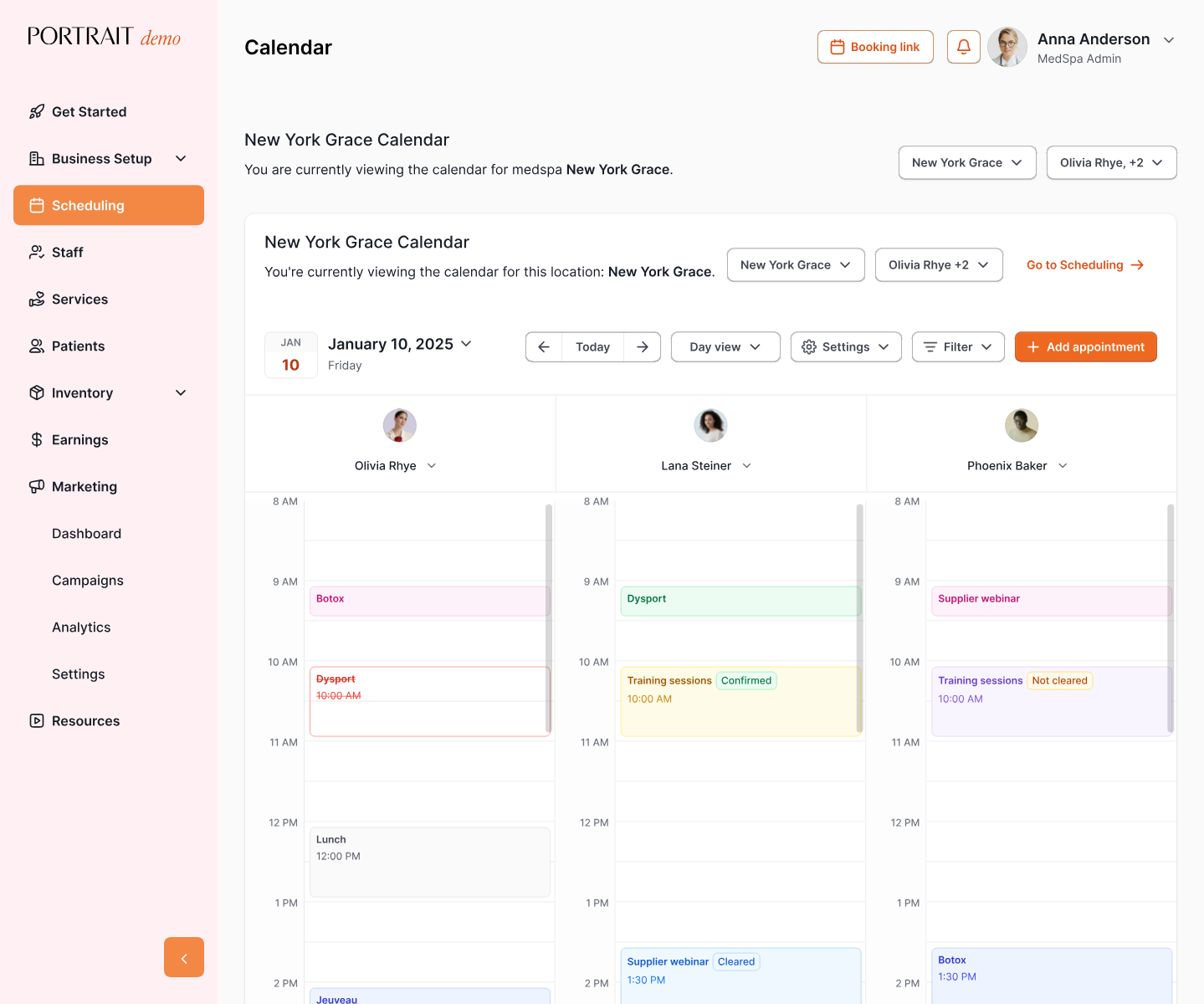

Stay Connected with Portrait Care
Subscribe to our email list and receive the latest insights, updates, and exclusive content delivered straight to your inbox.