Med spa valuation guide and free worksheet
Nov 4, 2026

Portrait Care Team
The Portrait Team
Empowering Professionals at Every Stage
Portrait offers strategic expertise to help you make informed decisions and achieve long-term success.
Book Intro CallHow much is my med spa worth?
Sovdoc (June 2025) quotes 3.0x to 5.0x adjusted EBITDA for med spas with under $500,000 of earnings, and Auxo Capital Advisors (June 2026) quotes 3.0x to 4.5x for smaller founder-led clinics. Both set your pay to a market wage before applying the multiple. Multiplying adjusted earnings gives you a starting point for discussion.
Advisers quote higher multiples for larger practices and platforms. Sovdoc's June 2025 Boise practice-sale adviser guide gives platforms with $3 million or more of earnings a top band of 8.0x to 10.0x or more. Read each range alongside its earnings basis and practice profile. Your books must show which earnings can continue after you leave, including the cost of replacing your work.
What advisers quote by practice size
Each band appears as its source published it, with the publication date. Sources do not agree, so check the practice size and earnings basis before comparing ranges.
From revenue to SDE, adjusted EBITDA and enterprise value
This example models a hypothetical single-location med spa. AmSpa's 2024 State of the Industry report (opens in a new tab) gives single-location med spas' 2023 average monthly revenue as $92,167 (p.5), or $1,106,004 annually by arithmetic. Its $1,398,833 average blends single- and multi-location spas (p.34), so it is not used here. Applying AmSpa's derived 38% operating margin (p.39) to this single-location revenue is an assumption. Staff payroll represents 30% of 2023 expenses (p.37). The report does not specify whether owners' own pay is included, so the table shows both cases.
Both bands multiply adjusted EBITDA with owner pay at market, so this example uses adjusted EBITDA, never SDE. Auxo's smaller founder-led clinic band, 3.0x to 4.5x, gives upper values of about $1.89 million (books already pay you) and about $1.3 million (books pay you nothing). Across both cases, enterprise value is about $864,000 to $2.1 million before debt, fees and taxes, not your sale proceeds. This example assumes staff on payroll handle management. If you also do management or other work that payroll does not cover, subtract a market wage for those hours too, but never subtract a role your payroll already pays for. AmSpa members were 71% of respondents (p.4); 50% opened their practice since 2020 (p.34). This is illustrative, not your value and not an appraisal.
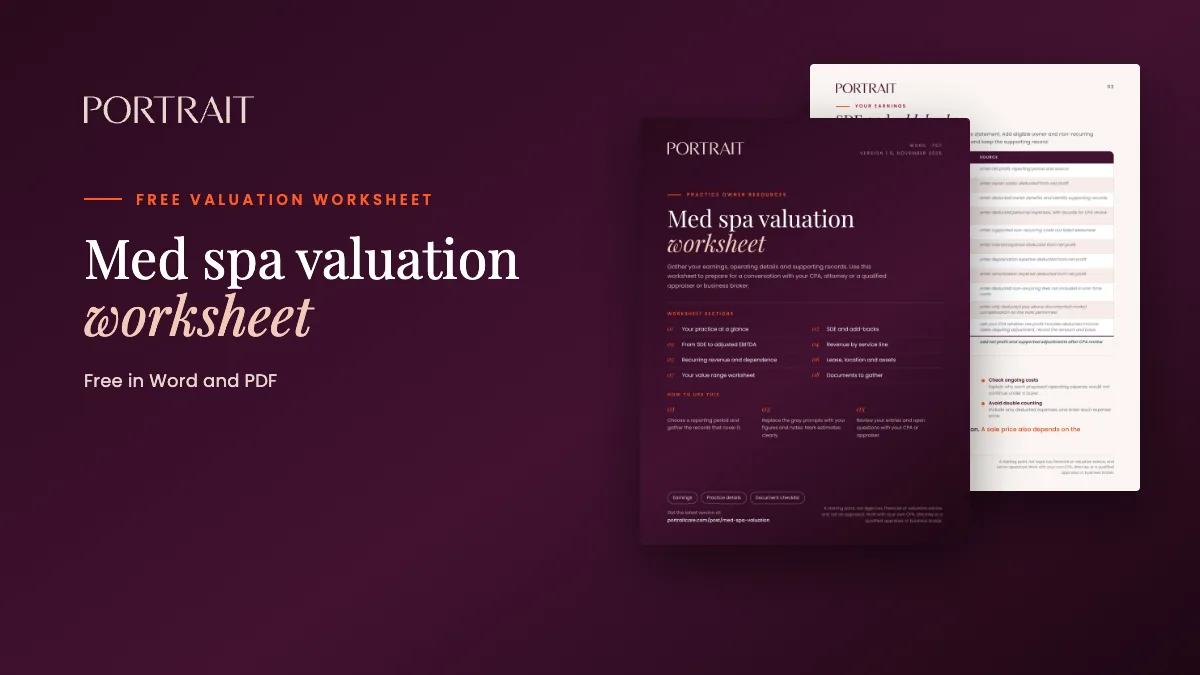
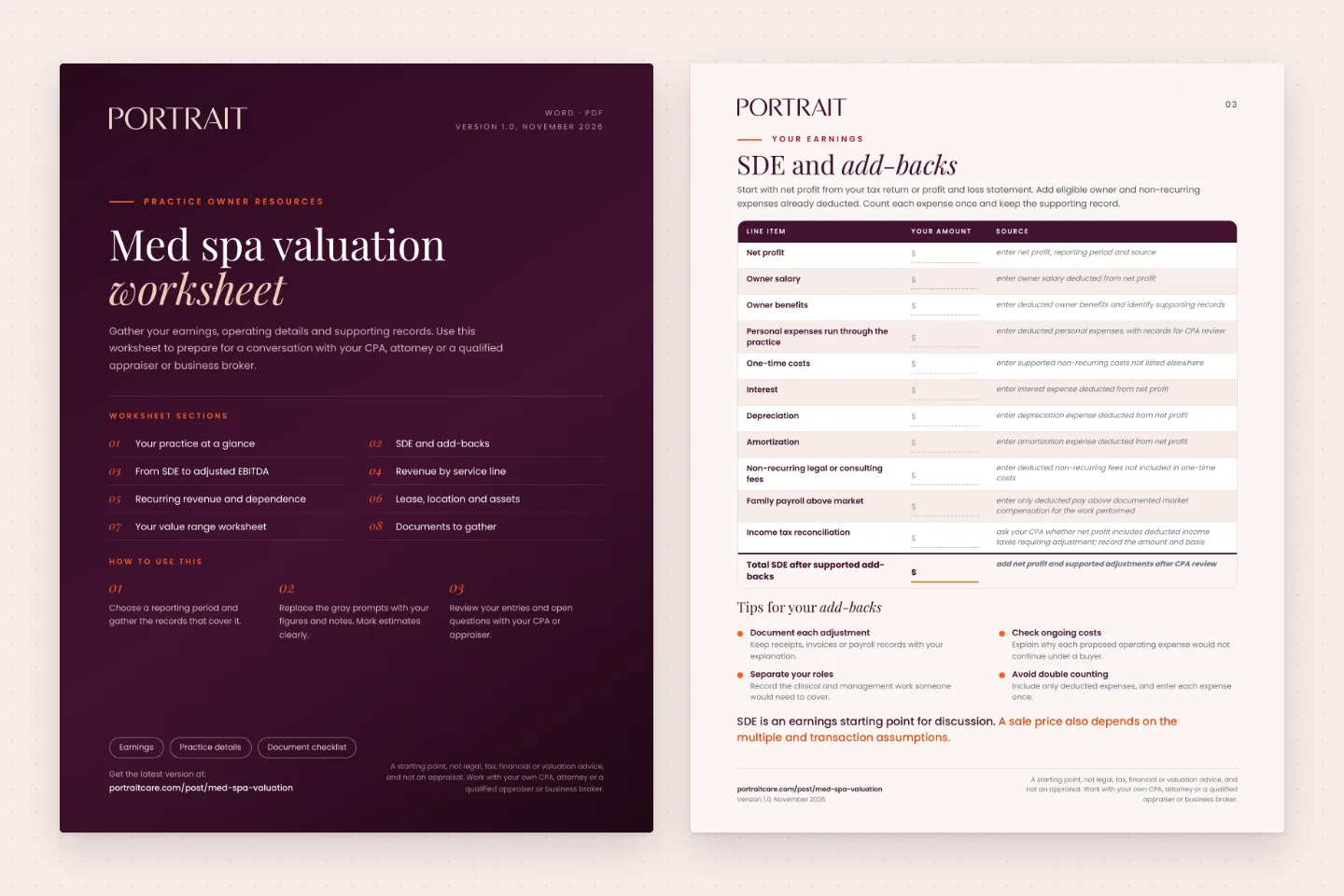
Free med spa valuation worksheet (Word and PDF)
Put your practice details and earnings in one place. Edit the Word file or print the PDF, then bring your completed worksheet to a CPA or appraiser.
 (opens in a new tab)
Open the preview to view the PDF.
Free valuation worksheet
Med spa valuation worksheet
Editable documentPrintable PDFDocument checklist
Download Word (.docx)
Open PDF(opens in a new tab)
Free. No email or sign-up needed.
Word (.docx) and PDF · 9 pages · Version 1.0, November 2026 · Word 121 KB · PDF 378 KB
Review how to sell your med spa.
Inside the med spa valuation worksheet
- SDE and add-backs: your net profit, owner compensation and supported adjustments.
- EBITDA: your replacement wages, adjusted earnings and sourced value range assumptions.
- Service revenue: your revenue and product cost by service line.
- Recurring revenue: your patient subscriptions, packages and services still owed.
- Team dependence: your provider revenue shares and work that depends on you.
- Lease and location: your lease terms, equipment and inventory details.
- Document checklist: your available records and documents you still need.
Should you use SDE or EBITDA for your med spa?
Use the earnings basis the quoted multiple uses: Sovdoc and Auxo quote on adjusted EBITDA with owner pay set to a market wage. Seller's discretionary earnings adds supported owner compensation and other eligible expenses back to net profit. EBITDA means earnings before interest, taxes, depreciation and amortization.
AmSpa's 2024 State of the Industry report includes staff payroll in average expenses, at 30% of 2023 expenses (p.37). The report does not say whether owners' own pay is included, so it cannot tell you how much of your work is already paid for. On your own books, add back any pay the books deduct for you, then subtract a market wage only for work you do, at the hours you work.
Replacing your clinical and management work at market wages reduces the earnings available to a buyer who will employ someone in your place. If you inject, list your clinical hours separately from time managing staff. Estimate the local cost of covering those responsibilities.
Start with the BLS median for nurse practitioners alone, $132,300 (May 2025, all settings) (opens in a new tab) as a reference for clinical replacement pay. The Bureau of Labor Statistics (BLS) also reports a median annual wage of $97,550 for registered nurses (opens in a new tab) in May 2025, across all settings. Neither figure is specific to med spas.
As a second reference, AmSpa's 2024 State of the Industry report gives 2023 average full-time compensation in med spas of $131,571 for nurse practitioners, $86,983 for registered nurses and $81,139 for practice managers (p.44). These figures come from samples of 40 to 52 respondents. Use the practice manager figure for management work. Match duties and hours to your actual role before estimating replacement pay.
The IRS reasonable compensation rule (opens in a new tab) requires S corporations to pay shareholder-employees reasonable compensation for their services before non-wage distributions. Talk to your CPA about that rule. The wage on your books may differ from a market-rate replacement wage.
When comparing med spa EBITDA multiples, confirm that the earnings already include the cost of replacing your work.
What multiple do med spas sell for?
Med spas sell at multiples that vary by earnings, practice size and buyer; the sourced table above shows what advisers quote.
A multiple connects adjusted earnings to a proposed business value, so changing either input changes the result. Ask which earnings measure each comparison uses, when the sale occurred and what the price included. An asking price alone does not show what a buyer paid.
Read each band alongside its practice profile. A founder-led clinic and a platform have different operating arrangements, so selecting the highest quoted multiple skips the comparison that matters. Ask your appraiser which profile fits your staffing and earnings, and what evidence supports that choice. Keep the reason beside the assumption in your worksheet.
In Close or sell your business (opens in a new tab), the SBA recommends using business valuation before marketing to buyers. Its guidance also suggests consulting a lawyer and a business evaluation expert when planning a business closure.
Online valuation calculators can provide a rough starting point, but a generic multiple cannot assess your replacement wages or transfer risks. The output depends on your inputs and the formula's assumptions. Bring the supporting records to your appraiser.
What moves your med spa's value up or down?
Earnings that can continue under new ownership support value; uncertain revenue or costs give a buyer reasons to question it. Separate patient subscriptions and packages from services already delivered. Record the treatments still owed and the resources needed to provide them.
AmSpa's 2024 State of the Industry report (opens in a new tab) says an average of 73% of med spa patients are repeat patients. That industry figure does not establish your retention rate. Show your own return visits and cancellations.
Product cost is a line buyers re-test. Each dollar of recurring cost removed adds a dollar to earnings, worth that dollar times the applied multiple, if revenue and other costs stay unchanged. Show supplier contracts and invoices so a buyer can assess whether the pricing continues after a transfer.
Break revenue and product cost out by service line. Keep product cost separate from total treatment cost, which also includes staffing.
Show revenue by provider and describe the work only you perform. If patients book specifically with you, explain how care would continue after you leave. Include your administrative work.
Lease terms also affect continuity. Gather renewal and assignment provisions for your attorney to review. Clean books let a buyer trace reported profit to supporting records; unexplained gaps leave the earnings assumption open to challenge.
How does the pool of eligible buyers affect your med spa's price?
The pool of eligible buyers affects your price discussions by determining whose offers you can consider. Who may buy or own a med spa varies by state. How a non-physician buyer can structure ownership also varies by state. Confirm with your state board and an attorney before planning around a buyer.
Bring your ownership documents and the proposed buyer's role to your attorney. Ownership requirements help determine which proposed transactions can proceed.
AmSpa's 2024 State of the Industry report says 67% of single-owner practices have owners who are neither MDs nor surgeons; only 3% of med spas are private equity owned. Those national findings do not establish permission for a particular buyer in your state.
Compare the work each buyer expects you to keep doing after a sale. A headline price means less without clear terms for your continuing role.
How do you prepare your numbers before a valuation?
Reconcile tax returns, profit and loss statements and payroll for matching periods, then document each proposed adjustment. Keep each expense record with your reason for adding it back. A supported add-back changes the earnings estimate by identifying a deducted cost that would not continue under the proposed operating arrangement.
Review doubtful items with your CPA. A recurring expense does not become an add-back because you would prefer a buyer to exclude it. Check that you have not counted a legal invoice both as a one-time cost and as a separate professional fee.
Keep the date and source with each figure. Separate confirmed entries from estimates so an appraiser can follow your assumptions.
Get a valuation when a sale, partner buy-in or other planned transaction requires a current estimate. Revisit the estimate after a material change, such as a provider leaving or a lease renewal. Ask a qualified appraiser how those changes affect the assessment you need.
The IRS Form 8594 instructions (opens in a new tab) generally require both buyer and seller to report a business asset sale when goodwill or going concern value attaches or could attach. The IRS explains in Publication 544 (opens in a new tab) that buyer and seller use the residual method to allocate the price across transferred assets. That allocation also determines the amount assigned to goodwill and certain other intangible property. Talk to your CPA about the filing requirements and allocation, and have your attorney review the sale documents.
How does Portrait fit?
Portrait supports supply purchasing and practice operations through an ecosystem that has a marketplace for licensed practices, plus practice software. It offers national-account pricing on supplies.
Core EHR is complimentary with Portrait membership and covers scheduling, charting, payments, inventory and reporting. Keeping these daily tasks in practice software helps you organize appointments and records as you run your practice.
Portrait does not practice medicine, is not a business broker, and does not value or buy practices. It gives no legal, tax or valuation advice. Talk to your attorney, CPA or a business broker for that advice.
Free valuation worksheet
Get your free valuation worksheet in Word or PDF. No email or sign-up needed.
Related reading
One Platform.
Everything You Need.
Everything You Need.
Portrait combines the technology, support, and savings to run and scale your modern medical wellness business.
Book Intro Call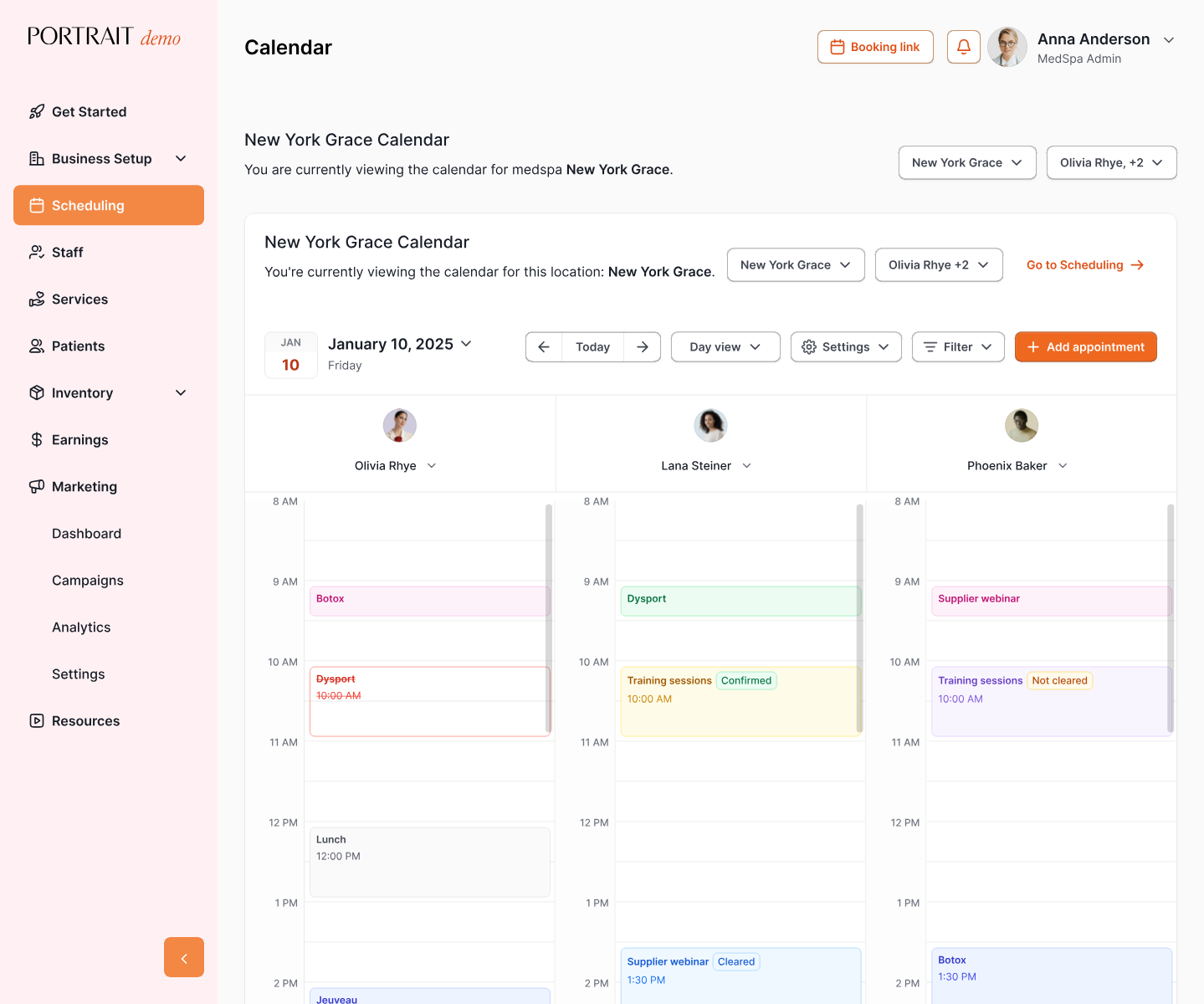

Stay Connected with Portrait Care
Subscribe to our email list and receive the latest insights, updates, and exclusive content delivered straight to your inbox.