Med Spa Policies and Procedures Manual: Free Word and PDF
Growth
Nov 6, 2026

Portrait Care Team
Khadija Sukhera

Empowering Professionals at Every Stage
Portrait offers strategic expertise to help you make informed decisions and achieve long-term success.
Book Intro CallBy Khadija Sukhera, Barrister, Lincoln's Inn · Last updated 2026-11-05
Your med spa policies and procedures manual records who does what, how you assess and treat patients, and how your team responds when something goes wrong.
Download the free template in Word and PDF below. Use it as a starting draft for your practice, with clinical details completed by your medical director and policies reviewed by your attorney.
What should your med spa policies and procedures manual include?
Your med spa policies and procedures manual should cover staff roles, patient assessment, consent, supervision, procedure protocols, infection control, emergencies, product storage, aftercare, privacy and policy review. Define its purpose and scope. Include how you document the good faith exam, treatment decisions and staff training.
The template includes an informed consent form, adverse event report, emergency contact form, and policy acknowledgment and sign-off. It closes with questions for your medical director and attorney. Use those questions to identify decisions you still need to make before adopting your manual.
Download your free manual in Word and PDF
Choose Word to edit your draft or PDF to review it. Version 1.0, November 2026, is about 23 pages, including a cover and instructions for using the manual. No email or sign-up needed.
 (opens in a new tab)
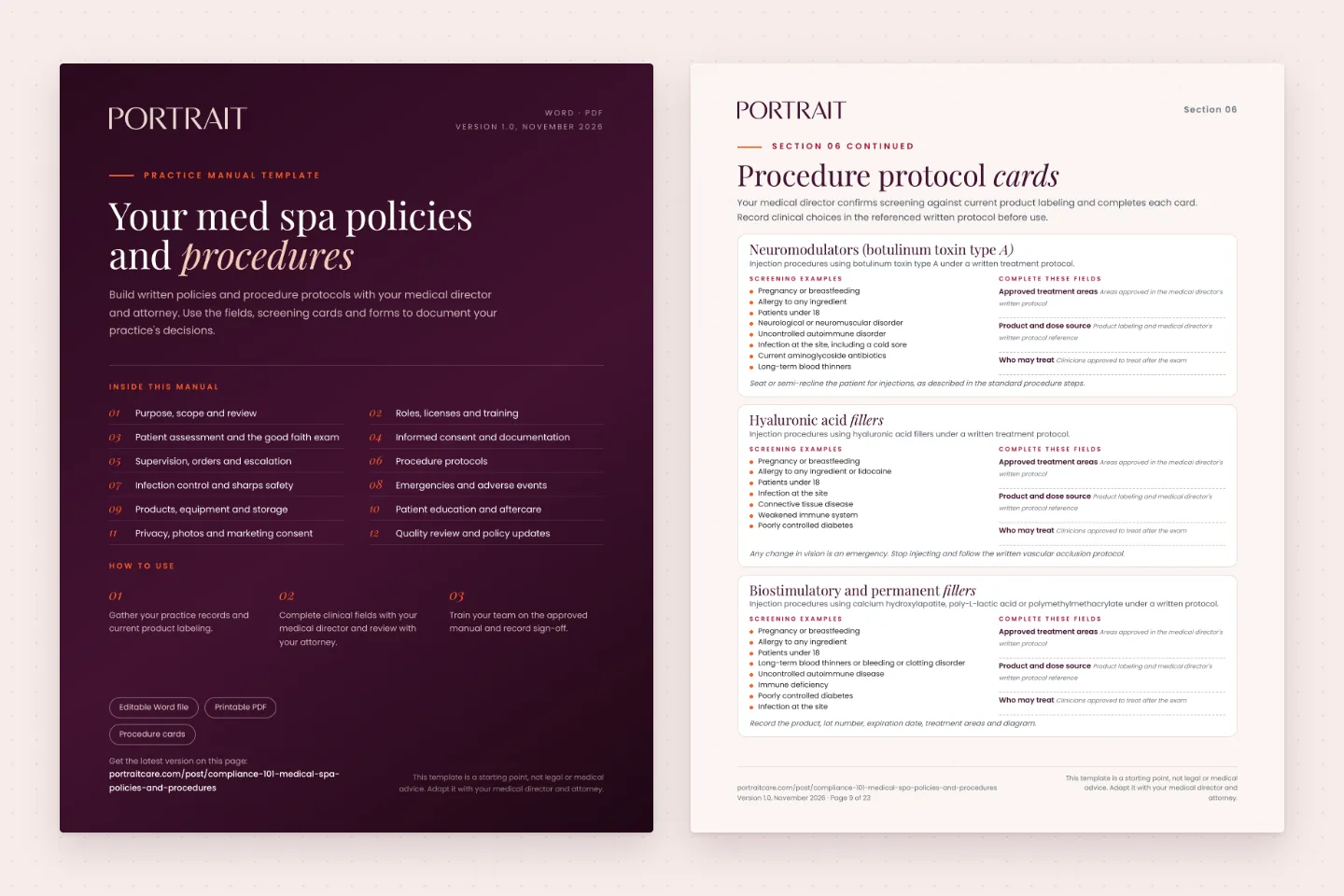
Preview the cover and a procedure protocol card
Your starting draft
Your med spa policies and procedures manual
12 sections4 appendix formsEditable Word file
Download Word (.docx)
Open PDF(opens in a new tab)
Free. No email or sign-up needed.
Word (.docx) and PDF · 23 pages · Version 1.0, November 2026 · Word 98 KB · PDF 815 KB
Inside your manual
- Purpose, scope and review: Define what your manual covers and when you review.
- Roles, licenses and training: Record who does what and their training.
- Patient assessment and the good faith exam: Document assessment before treatment.
- Informed consent and documentation: Record consent discussions and treatment decisions.
- Supervision, orders and escalation: Write down supervision arrangements and escalation contacts.
- Procedure protocols: Complete a card for each procedure family you offer.
- Infection control and sharps safety: Set out infection prevention and exposure response.
- Emergencies and adverse events: Document response steps and adverse events.
- Products, equipment and storage: Describe how you handle products and equipment.
- Patient education and aftercare: Set out aftercare instructions and follow-up.
- Privacy, photos and marketing consent: Document how you handle information and photo permissions.
- Quality review and policy updates: Record reviews, changes and approval.
Who writes and approves your manual?
Draft your manual with your medical director and practice owner. Your medical director completes and approves the clinical protocols. As the owner, document how your team puts those policies into daily practice. Assign responsibility for keeping the manual current.
Ask your attorney to review ownership, staffing and policies against the rules that apply to your practice. Start with what license you need to open a medical spa when planning your team. Train your clinicians on the approved policies and have them complete the policy acknowledgment and sign-off.
How do state rules change your manual?
Build your manual around your state's scope of practice and supervision rules. Work with your medical director and attorney to document who can perform each procedure, who conducts the good faith exam, and how orders and supervision work. The template leaves these arrangements for your medical director to complete.
For an example of state differences, the Medical Board of California (opens in a new tab) says registered nurses and physician assistants may give neurotoxin injections only under a physician's supervision. Unlicensed staff, such as medical assistants, may not give them.
If you are still building your clinical team, read how to find a qualified medical director. Discuss the procedures you plan to offer, the supervision arrangements and who will review your written protocols.
What federal rules shape your manual?
OSHA's bloodborne pathogens standard (opens in a new tab) applies to employers whose staff can be exposed to blood at work. It calls for a written exposure control plan, reviewed and updated at least annually. Use the infection control and sharps safety section to document your practice's approach.
Under the HIPAA authorization rule (opens in a new tab), if your practice is covered by HIPAA, you need the patient's written authorization before using their information or photos in marketing. Address this in your privacy, photos and marketing consent policies.
Health professionals can report serious adverse events and product problems to FDA through FDA's MedWatch program (opens in a new tab). Use your adverse event report form to document what happened and your response. Alongside these federal topics, review the rules for registered nurses who own or work in a med spa when assigning clinical responsibilities.
How do you adapt the procedure protocol cards?
Keep the cards for the procedure families you offer. Have your medical director complete each from current product labeling and their written protocol. Every dose, product, treatment area, supervision arrangement and emergency medicine is a fill-in for your medical director. The template contains no doses or brand names.
The 11 families are neuromodulators, hyaluronic acid fillers, biostimulatory and permanent fillers, deoxycholic acid injections, microneedling, platelet-rich plasma and fibrin, absorbable threads, sclerotherapy, IPL and light devices, chemical peels, and vitamin injections and IV infusions.
Have your medical director adapt the screening lists for each procedure, including relevant history, contraindications and reasons to defer treatment. Document consent, aftercare and escalation steps in your approved protocol. Review the completed cards with the clinicians who will use them before putting them into practice.
How often should you review and update your policies?
Schedule a review at least annually. Review affected policies when you add services, devices or products, and after incidents. Check whether your written instructions still reflect the care you provide and the way your team works.
Keep a review log with the date, policy reviewed, changes and sign-off. Have your medical director approve clinical revisions and your owner confirm operational changes. Bring legal questions to your attorney. Train affected staff on the revised policies and record their acknowledgment.
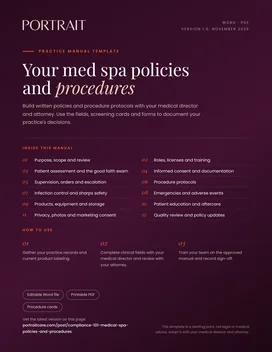
Start your draft
Download the manual, then work through the clinical details with your medical director.
Related reading
One Platform.
Everything You Need.
Everything You Need.
Portrait combines the technology, support, and savings to run and scale your modern medical wellness business.
Book Intro Call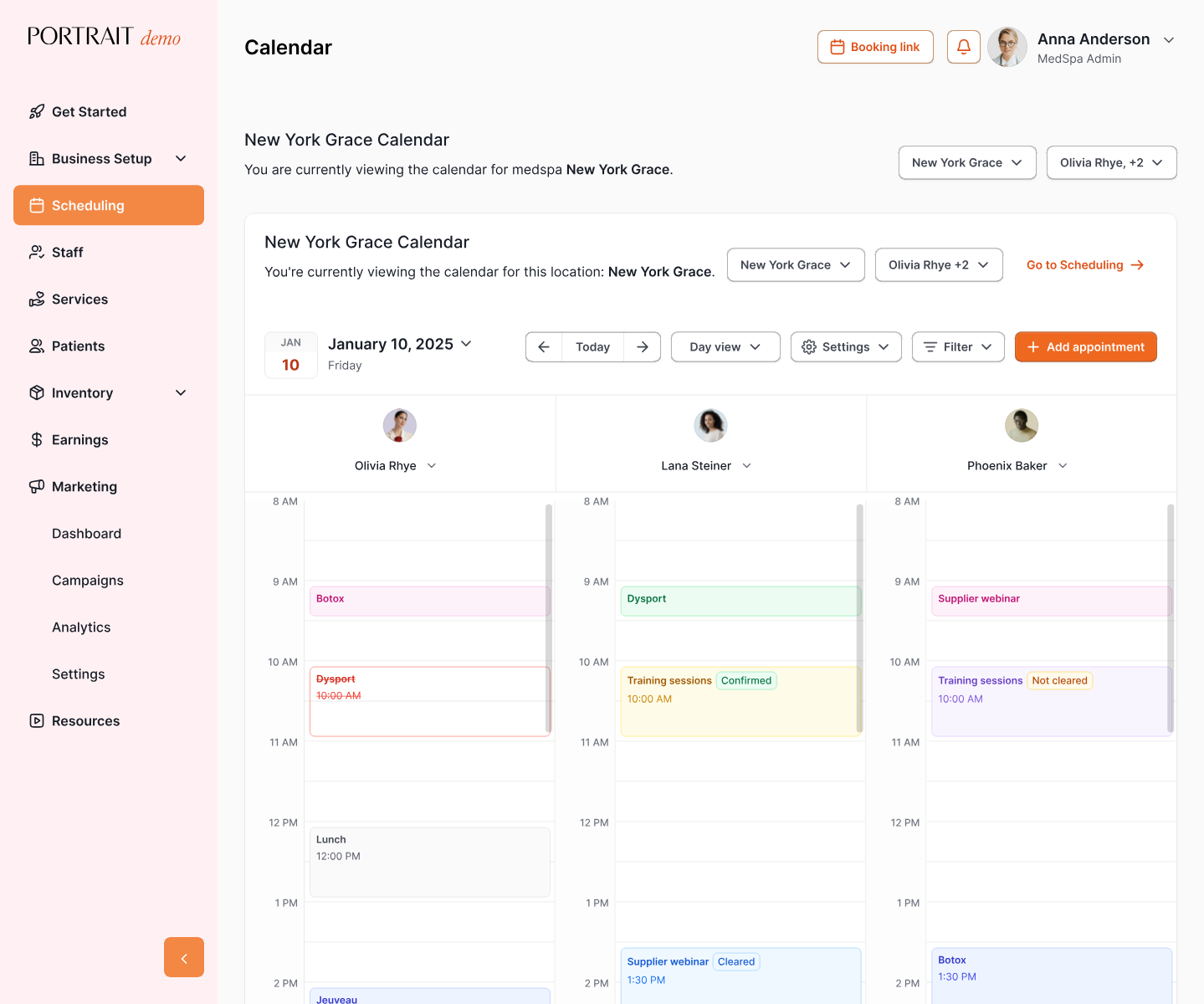

Stay Connected with Portrait Care
Subscribe to our email list and receive the latest insights, updates, and exclusive content delivered straight to your inbox.