On this page
This is a template, not medical or legal advice; adapt it with your medical director and attorney.
Your med spa emergency protocol should name who responds, what they do, whom they contact and how they record an event. Start with the safety readiness checklist and adverse event protocol template below.
Download the Word and PDF files, then adapt them with your medical director and attorney. You get planning fields, an event report and logs for kit checks and drills.
What should your med spa adverse event protocol include?
Your med spa adverse event protocol should include response roles, clinical instructions, emergency contacts, referral arrangements, documentation and follow-up responsibilities. Have your medical director complete and approve the clinical content. Record who keeps the plan current and where your team can find it.
Pair your response plan with a med spa emergency kit checklist and a drill log. The template provides fields for kit contents, storage, expiry and location. Your medical director chooses the contents; your practice team records checks and rehearsals.
Download your free template in Word and PDF
Use the Word file to prepare your working copy or print the PDF for review. Both include instructions, checklists, response planning fields, event records and questions for your medical director.
 (opens in a new tab)
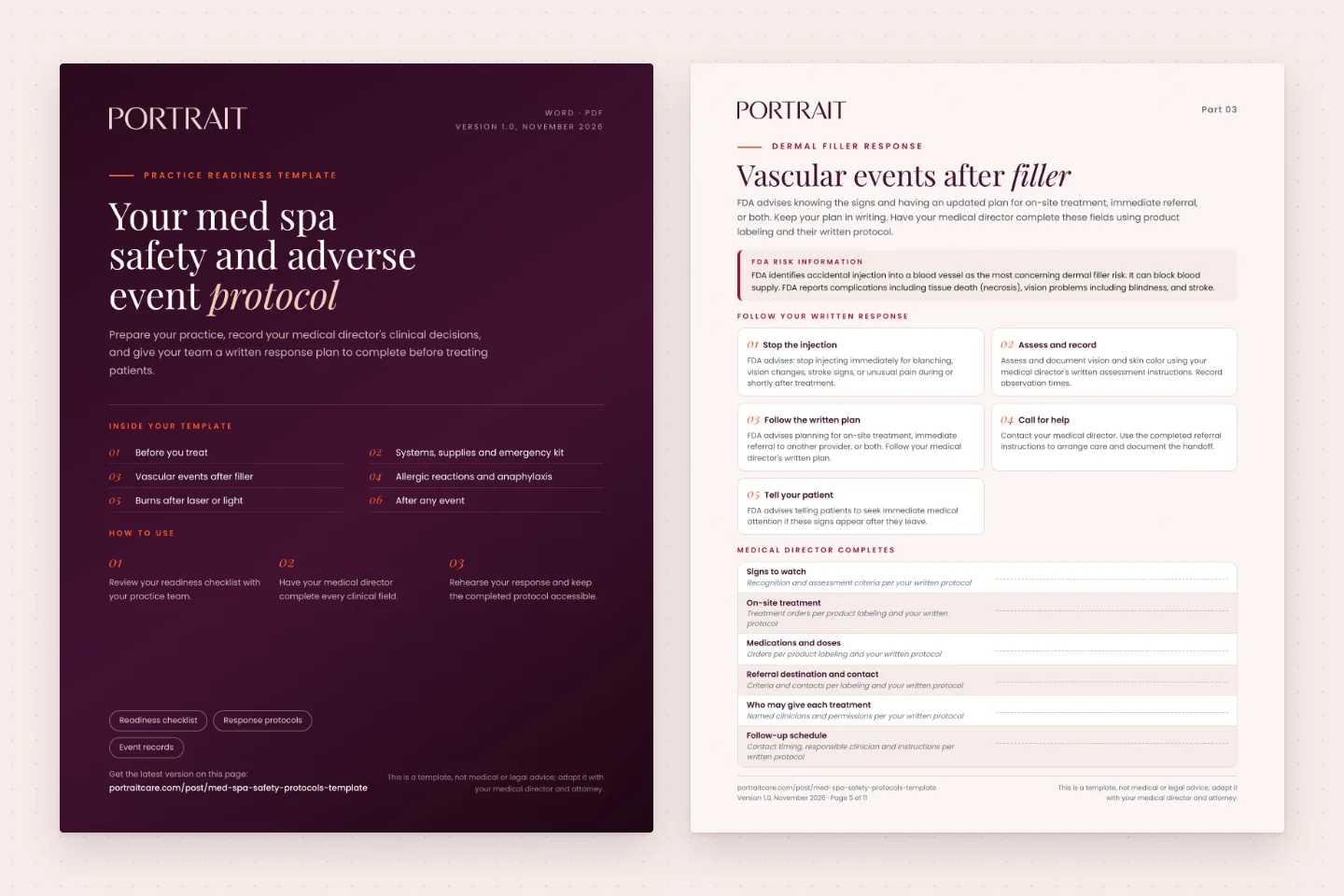
View the cover and a protocol page before you download.
Your practice planning file
Your med spa safety and adverse event protocol
Free. No email or sign-up needed.
Word (.docx) and PDF · 11 pages · Version 1.0, November 2026 · Word 89 KB · PDF 374 KB
What you get
- Before you treat: Review your business and clinical readiness tasks.
- Systems, supplies and emergency kit: Record your kit contents and check arrangements.
- Vascular events after filler: Complete your clinical response and referral fields.
- Allergic reactions and anaphylaxis: Record your recognition criteria and emergency contacts.
- Burns after laser or light: Complete your assessment and device documentation fields.
- After any event: Assign your documentation, follow-up and review tasks.
- Adverse event report: Record your observations, actions, contacts and times.
- Kit check and emergency drill log: Track your checks, rehearsals and follow-up work.
Who writes and approves your med spa emergency protocol?
Have your medical director decide and approve the clinical content. As the owner, run drills and keep the logs. Train your staff on their assigned roles, contact details and recordkeeping. Use your med spa policies and procedures manual to organize the approved documents. Check with your state board and attorney about legal questions.
OSHA's bloodborne pathogens standard (opens in a new tab) calls for a written exposure control plan for occupational exposure to blood or other potentially infectious materials. Review and update it at least annually. Put contaminated sharps in closable, puncture-resistant containers, leakproof on the sides and bottom, and labeled or color-coded. Assign responsibility for maintaining your exposure plan alongside your practice's other written procedures.
How do you prepare for a vascular event after filler?
Have your medical director complete your vascular occlusion protocol before you offer dermal fillers. Record clinical decisions, response roles and referral contacts in the template. Rehearse how your team accesses the plan and communicates during an event.
FDA's dermal fillers page (opens in a new tab) calls blood-vessel injection the most concerning risk: tissue death, vision problems including blindness or stroke can follow. FDA advises knowing the signs and having an updated plan for on-site treatment, immediate referral, or both. Keep your plan in writing. Stop injecting immediately for blanching, vision changes, stroke signs or unusual pain. Tell every patient to seek immediate medical attention if these signs appear after they leave.
Use the medical director interview guide to discuss responsibility for writing, approving and reviewing your protocol. Record backup contacts and who handles each communication step.
How do you prepare for allergic reactions?
Have your medical director complete recognition criteria, clinical orders and handoff instructions before you use the template. Assign someone to call emergency services for a severe reaction and someone to notify your medical director. Follow the written protocol and record your actions and times.
The epinephrine auto-injector labeling (opens in a new tab) lists epinephrine for emergency treatment of allergic reactions, including anaphylaxis. It directs injection into the outer thigh and immediate medical care after use. Have your medical director use the labeling for the epinephrine product you stock when completing your written clinical instructions.
What should you do after any adverse event?
Document what happened, notify your medical director and record the instructions you receive. Assign patient follow-up according to your completed protocol. Use the event report to capture observations, actions, contacts and times. Review the sequence with your team, assign corrections and have your medical director approve clinical revisions.
Use FDA's MedWatch program (opens in a new tab) to report serious adverse events and product problems, including device problems. Record who submits the report and retain its reference with your event documentation.
Prepare your working copy
Complete your template with your medical director, review legal questions with your attorney and rehearse with your team.