Best Laser Equipment for Dermatology Practices in 2026
Oct 15, 2026

Portrait Care Team
The Portrait Team

Empowering Professionals at Every Stage
Portrait offers strategic expertise to help you make informed decisions and achieve long-term success.
Book Intro CallLooking for the best laser equipment for your dermatology practice in 2026? You need tech that keeps patients coming back, helps your staff work efficiently, and makes growing your business easier. The right device gives you new high-margin services. The wrong pick? You're stuck with a costly machine that collects dust.
Discover the top laser devices for dermatology, what you should think about before you buy, and how Portrait helps you manage laser-based services with zero admin headaches.
Evolving Laser Technology in Dermatology
Medical lasers have made huge leaps since the early 2000s. They're faster, more precise, and a lot more versatile. The global dermatology treatment devices market hit USD 8.35 billion in 2024 and aims to reach USD 40.25 billion by 2035. Clinical demand, not just hype, is driving that.
Here’s why:
- Patients want real results with less downtime.
- Clinicians want devices that tackle more than one concern in less time.
- Manufacturers have stepped up, so today's lasers use hybrid, multi-wavelength platforms to address several issues at once.
Think picosecond and fractional lasers. They resurface the skin, fade pigmentation, reduce wrinkles, and healing is quicker and less painful. IPL photofacials are great for redness, sunspots, and hyperpigmentation without keeping patients out for days.
Now, you can do more with fewer lasers, and you keep your patients happy.
How to Choose the Best Laser Equipment for Your Dermatology Practice
Before you make a big purchase or sign a lease, keep a few key things in mind.
- ROI and total cost of ownership. Think beyond the sticker price. You'll pay for service contracts, and some run up to $10,000 a year. There's also maintenance, consumables, and follow-up visits. One practice expected their laser to make at least $7,000 monthly once their staff got the hang of it. They took a 36-month lease so upfront costs wouldn't be a problem. That's a solid template.
- Device versatility. You don't want a one-trick pony. Get a platform with multiple wavelengths or upgrade options, so you can treat different needs as your practice grows.
- Training and support. Hardware's only as good as your staff. Check if the manufacturer offers onboarding, ongoing hands-on training, and clinical support. Certification courses range from $699 to $2,299, so factor that in.
- Patient demographics. Fitzpatrick skin type matters. Some lasers do best on lighter skin, while others are for darker skin. Match your device to the patients you actually see.
Laser Types and Applications
- CO2 lasers (10,600 nm) are your go-to for ablative resurfacing. They're effective for wrinkles, skin laxity, and even keratinocyte skin cancers. Fitzpatrick types I-II do best with CO2 lasers, but fractionated delivery makes types III-VI possible. Top platforms are Lumenis UltraPulse, DEKA SmartXide, and Candela Co2re.
- Nd:YAG lasers (1064 nm) go deeper with less damage to the epidermis. They’re the first choice for Fitzpatrick IV-VI and work for hair removal, vascular treatments, scars, and rejuvenation.
- Alexandrite lasers (755 nm) are considered the gold standard for hair removal on lighter skin (Fitzpatrick I-III). They treat hair quickly and are usually more comfortable than Nd:YAG for these patients.
- Picosecond lasers deliver super-short pulses of 300-900 picoseconds for more photomechanical and less photothermal action. That means they smash pigment particles with minimal thermal damage. 755 nm picosecond alexandrite lasers outperform Q-switched Nd:YAG for melasma, so if pigmentation is big for your clinic, don’t skip these.
Device Reliability and Upgradability
Buying a laser platform is a long-term move. Always ask vendors about software updates, modular upgrades, and what's covered under warranty. Choose devices you can expand, like adding wavelengths or treatment heads, so you're never boxed in.
Vendor reputation matters. Lumenis, Cynosure, Sciton, and Candela Medical have long records. When you need service or a replacement part, it's good to deal with a reputable supplier.
How to Future-Proof with the Best Laser Equipment for Dermatology Practices
The tech changes fast. Next-gen lasers use AI algorithms for real-time treatment optimization. They're sharper on safety and customization. Look out for imaging systems, temperature control, and even laser-assisted drug delivery hitting the market soon.
You don't have to buy every new bell and whistle. Just make sure your platform evolves with you. Ask these questions before you commit:
- Does the device's roadmap include AI or multi-spectrum upgrades?
- Can you add new treatment heads or wavelengths later?
The fractional hybrid lasers that combine ablative and non-ablative energy in one session are already on the market. If your device can't grow, you'll fall behind.
Leasing is smart. It keeps your options and your cash flexible. When something better comes out, you're not stuck. Pair that with a supply chain strategy to keep consumable costs under control.
Integrating Laser Technology with Portrait's Marketplace
Buying a laser is just step one. Running it efficiently is step two. That's where practices struggle. Portrait handles all your daily operations, so your team isn't drowning in busywork.
- Scheduling. Lasers need longer appointments and certain providers. Portrait's scheduling tools make it simple. You can manage appointments, set automatic reminders, and fill your laser providers’ schedules. Missed laser slots waste money, so Portrait's SMS reminders help cut no-shows by 40-50%.
- EHR and treatment notes. You’ve got to keep detailed, HIPAA-compliant records for every treatment. Portrait keeps all history, consent, notes, and photos in one spot for each appointment. Our guide to the best EMR for aesthetic practices in 2026 breaks down why documentation and inventory tracking are non-negotiable for safety and compliance. Portrait makes both easy.
- Inventory. Laser services burn through consumables, and running out mid-week is a nightmare. Portrait manages your inventory, automates reordering, and keeps waste low. Our Integrated Preferred Supply Chain comes with exclusive supplier deals on devices, injectables, and more, helping you save up to 60% on select products. That adds up when you run multiple laser sessions each week.
- Marketing your laser services. Just buying a laser doesn't bring patients in. You need to market it. Portrait's marketing tools help spread the word. Check out our guide for growing your dermatology clinic to see how we use SEO, paid ads, social media, and automated email and SMS to get new bookings for your latest services.
If you're planning a new practice, our start-up guide walks you through equipment planning and setting up your software and suppliers from day one.
Stay Ahead of the Curve in 2026
The practices winning in 2026 are combining the best tech with simple, effective daily operations. Get the right laser equipment, and you’ll have what you need clinically. Use Portrait, and you’ll keep things running smoothly and profitably.
From appointments and charting to inventory, supply deals, and marketing, Portrait sits underneath your laser service so nothing gets missed. Want to see how it works in your own practice? Take a closer look at Portrait.
Savings vary by practice, product mix, and order volume. Figures reflect select products and are not guaranteed.
Related reading
One Platform.
Everything You Need.
Everything You Need.
Portrait combines the technology, support, and savings to run and scale your modern medical wellness business.
Book Intro Call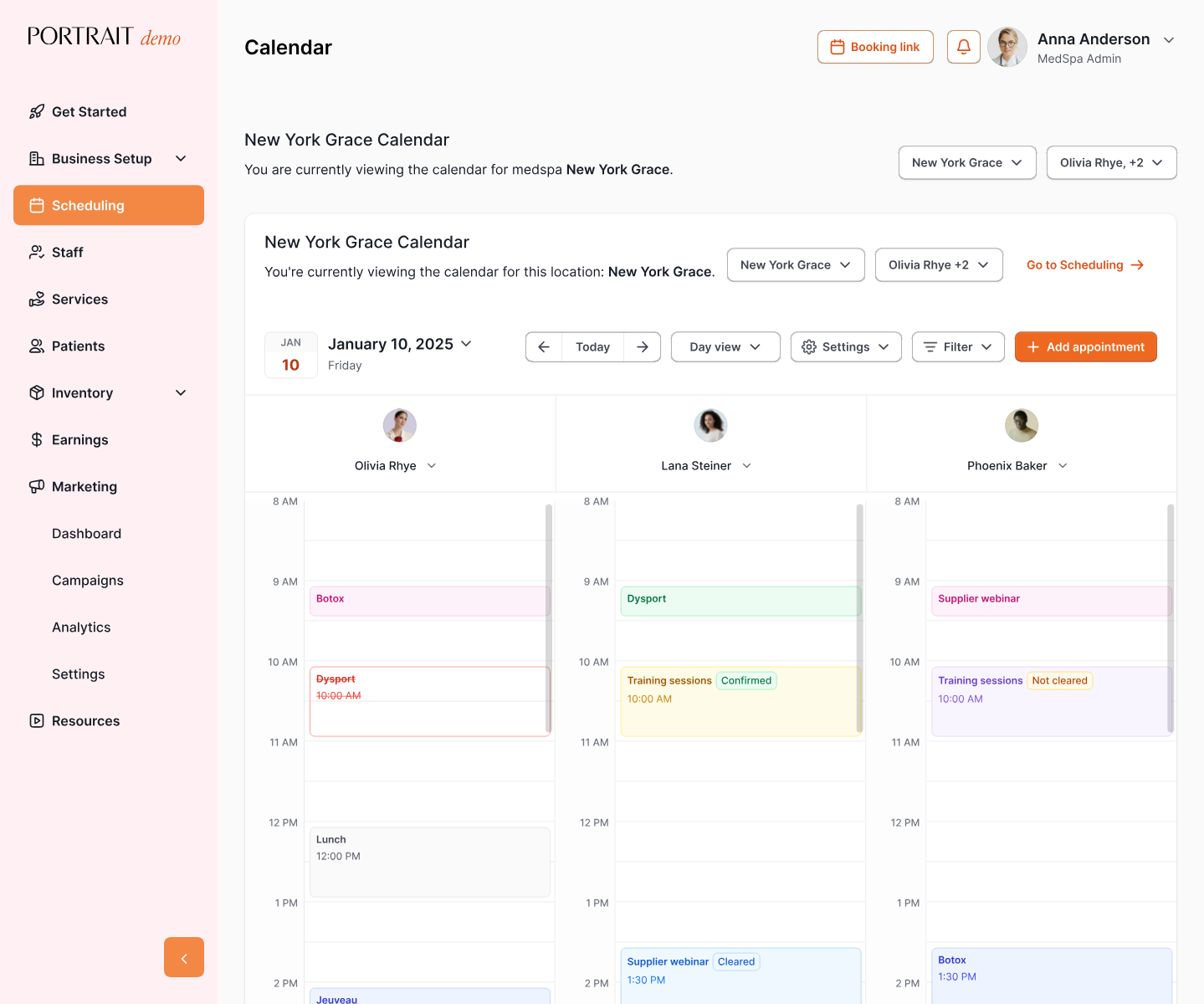

Stay Connected with Portrait Care
Subscribe to our email list and receive the latest insights, updates, and exclusive content delivered straight to your inbox.