How to sell a med spa: Steps and free checklist
Nov 6, 2026

Portrait Care Team
The Portrait Team

Empowering Professionals at Every Stage
Portrait offers strategic expertise to help you make informed decisions and achieve long-term success.
Book Intro CallHow do you sell a med spa?
To sell a med spa, prepare your numbers and records, set a value range, choose how to reach buyers, then negotiate, run diligence and close with your attorney and CPA. Selling a med spa means showing what a buyer would take over, including the work you do yourself. Buyers compare reported earnings with the records behind them to assess what could continue after you leave.
Start preparing before you approach potential buyers. The SBA recommends a business valuation before marketing to buyers. Review what your med spa is worth with a business broker or qualified appraiser. Use the phases below and the checklist to organize the records behind that discussion.
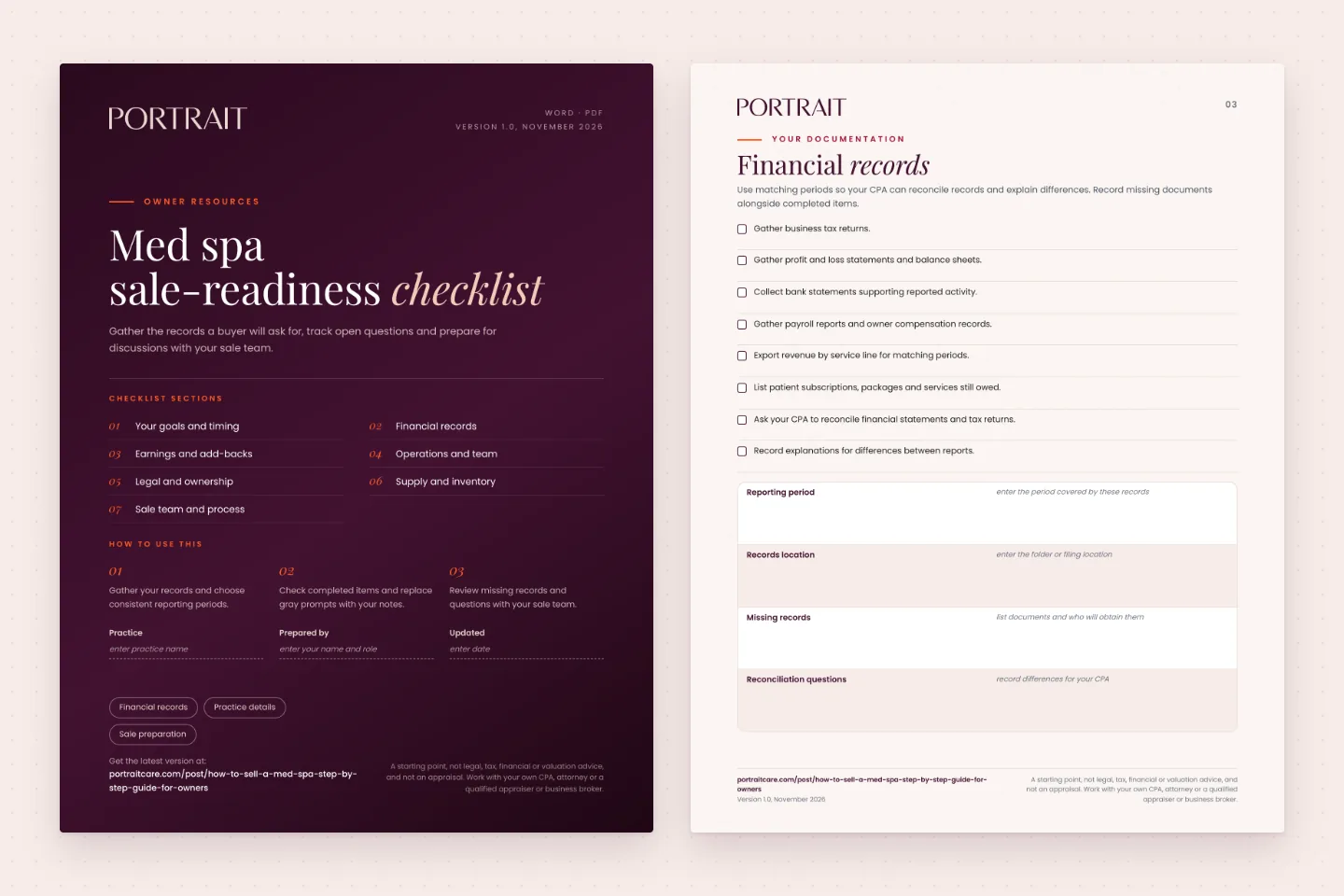
Free med spa sale-readiness checklist (Word and PDF)
Gather the records a buyer will ask for and track what needs attention. Edit the Word file or print the PDF. Both are free, with no email or sign-up needed.
 (opens in a new tab)
Open the preview to view the PDF.
Free sale-readiness checklist
Med spa sale-readiness checklist
Editable documentPrintable PDFFinancial records checklist
Download Word (.docx)
Open PDF(opens in a new tab)
Free. No email or sign-up needed.
Word (.docx) and PDF · 8 pages · Version 1.0, November 2026 · Word 116 KB · PDF 275 KB
See what your med spa is worth before setting an asking price.
Inside the checklist
- Your goals and timing: your reasons for selling and preferred role afterward.
- Financial records: tax returns, financial statements and supporting reports.
- Earnings and add-backs: proposed adjustments and the evidence behind them.
- Operations and team: owner responsibilities, existing agreements and practice policies.
- Legal and ownership: entity records, lease terms and questions for your attorney.
- Supply and inventory: supplier terms, product costs and stock on hand.
- Sale team and process: professional support, confidentiality and agreement preparation.
When is the best time to sell a med spa?
The best time to sell a med spa is when your numbers are clean, the practice runs without you and the timing fits your goals. A calendar date cannot tell you that. Start by deciding how much work you want to keep doing after a sale.
Owner dependence affects a buyer's costs because someone must take over the work you leave behind. Document your clinical and management duties. Identify who handles purchasing and staff questions when you are away. If every decision comes back to you, work on delegation before presenting the practice to buyers.
A short runway can narrow your buyer options and leave less room to fix missing records or unresolved contracts. Give yourself time to address those issues alongside your daily work.
How long a med spa sale takes depends on readiness and buyer path, including financing and unresolved deal questions. Ask your business broker or attorney to assess the work ahead and a timeline for your practice.
What do buyers check in due diligence?
Buyers check whether your financial records, contracts and operations support the practice described in your offer discussions. Due diligence tests reported earnings against evidence and identifies obligations the buyer may take on.
Before you approach buyers, prepare a document folder covering:
- Tax returns and profit and loss statements that reconcile, with explanations for differences.
- Proposed add-backs, the original expenses and supporting invoices or payroll records.
- Revenue by service line, patient subscriptions, packages and services still owed.
- Provider and staff agreements, plus your existing medical director agreement and its cost.
- Entity documents and ownership questions for your attorney and state board.
- Your lease, assignment terms and equipment ownership or financing records.
- Supplier accounts, product cost reports and inventory details.
Keep reporting periods consistent so a buyer can compare records. Assign responsibility for each request, including missing documents. Keep a request log with the document needed, who will supply it and what remains unresolved. That gives you a way to track follow-up while you continue running the practice.
Ask your CPA to explain proposed earnings adjustments before they enter an offer discussion. An expense you plan to remove may still be needed by the next owner. Keep the original records beside each explanation so the buyer can follow the reasoning and raise specific questions.
For HIPAA covered entities, 45 CFR 164.501 (opens in a new tab) includes qualifying sales and related due diligence within health care operations. The definition concerns transactions with another covered entity or an entity that will become one. Ask your attorney how to handle patient records and buyer access in your transaction.
How does product cost affect your sale price?
Product cost affects your sale price through the earnings a buyer evaluates and the costs expected after closing. Each dollar of recurring cost removed adds a dollar to those earnings, assuming revenue and other costs stay unchanged. If a buyer applies an earnings multiple, that multiple also applies to the earnings change.
Show what you pay for product as a share of revenue, using matching reporting periods. Include supplier invoices and explain changes in service mix. A buyer may recheck your calculations against purchasing records and inventory on hand.
Separate current pricing from terms a new owner could receive. Ask suppliers whether accounts and pricing transfer, and keep their written responses. Review open orders alongside expiry dates. Stock that cannot be used before expiry needs attention in the inventory discussion.
Lower purchasing costs only support the earnings discussion if they can continue. Document changes already reflected in your records and distinguish them from plans.
Who buys med spas?
Potential med spa buyers include individuals, local operators, management services organizations (MSOs), private equity (PE)-backed groups, and partners or employees. Buyer type affects financing and the role you may be asked to keep after closing.
Use these descriptions to prepare questions for a prospective buyer. TUSK's September 25, 2025 guidance describes greater role flexibility when the owner is not the key clinician, with the team and systems in place before stepping back. Ask who would take over your work and what the buyer expects you to keep doing. Confirm financing with the buyer and their lender before relying on an offer.
AmSpa's 2024 State of the Industry report (opens in a new tab) surveyed 2023 data and found that only 3% of med spas were PE-owned (p.14). Its survey of 375 med spa owners and staff was fielded from September 2023 to March 2024.
Compare how and when you would receive payment, alongside the headline price:
- Cash at close: the portion of the price paid when the deal closes.
- Seller note: the buyer's written promise to repay an amount owed to you over time.
- Earnout: payment tied to agreed future performance conditions.
- Rollover equity: an ownership interest you retain or receive in the continuing business.
- Non-compete: a proposed contract restriction on competing activities after the sale.
Selling a med spa to an MSO requires reviewing the proposed ownership structure and any management services agreement. Who may buy or own a med spa, and how a non-physician buyer can structure ownership, varies by state. Confirm with your state board and an attorney.
How do you list a med spa for sale?
You can reach buyers through a business broker, online listing sites or private outreach to your network and local operators. Groups that approach you directly are another possible contact. Choose a route based on the work you can handle and the buyer reach you need.
A confidential summary gives prospective buyers context before you share detailed numbers. Describe the practice without exposing patient information. Have your attorney prepare a nondisclosure agreement (NDA) before sharing financial records.
When comparing business brokers, ask about relevant completed work, buyer screening and who will handle document requests. Review fees and the scope of representation before hiring. If you handle the sale yourself, account for the time spent fielding inquiries while running the practice.
The SBA's sales agreement guidance says to record adjustments and broker fees in the sales agreement. Ask your attorney to review the terms before you commit.
What taxes and paperwork come with selling a med spa?
Selling a med spa involves a written sales agreement under the SBA's guidance, plus tax reporting that depends on the transaction. The IRS explains in Publication 544 (opens in a new tab) that a business sale usually involves multiple assets, each generally treated separately when determining gain or loss. That separate treatment means the total price alone does not explain the tax result.
The IRS's Instructions for Form 8594 (opens in a new tab) say both seller and purchaser must report a sale of business assets when goodwill or going concern value attaches, or could attach. Talk to your CPA about how this applies. Bring asset versus stock sale questions to your CPA and attorney.
The SBA's sales agreement guidance calls for attorney review, a full inventory list, adjustments and broker fees, without omitting assets or liabilities. Gather these records before drafting the agreement. Ask your attorney to document the handover responsibilities and review unresolved contract questions. Agree with the buyer on when and how to tell staff and patients about the sale, and ask your attorney how patient records should be handled during handover.
How does Portrait support your practice today?
Portrait supports daily operations through supply purchasing and practice software. Portrait is an ecosystem that has a marketplace for licensed practices, with national-account pricing on supplies. The marketplace gives licensed practices access to those supply terms for their current purchasing needs. Members can save up to 60% on select products.
Savings vary by practice, product mix, and order volume. Figures reflect select products and are not guaranteed.
Portrait also offers practice software. Core EHR is complimentary with Portrait membership and covers scheduling, charting, payments, inventory and reporting. You can use these functions to manage appointments, document care and track daily practice activity.
Portrait does not practice medicine, is not a business broker, does not value or buy practices, and gives no legal, tax or valuation advice. For that advice, talk to your attorney, CPA or a business broker.
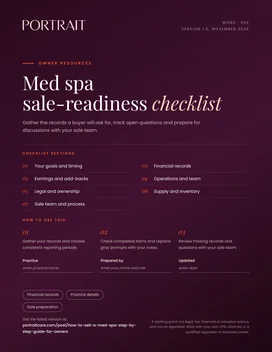
Free sale-readiness checklist
Get your free sale-readiness checklist in Word or PDF. No email or sign-up needed.
Related reading
- Average med spa revenue, owner salary and profit margin
- What Is an MSA (Management Services Agreement)?
- How to Scale a Med Spa: Practical Steps for Growth
Save up to 60% on select products
Portrait brings marketplace purchasing and practice software together to support your daily operations. Actual savings vary by product and purchasing needs. See your supply pricing.
One Platform.
Everything You Need.
Everything You Need.
Portrait combines the technology, support, and savings to run and scale your modern medical wellness business.
Book Intro Call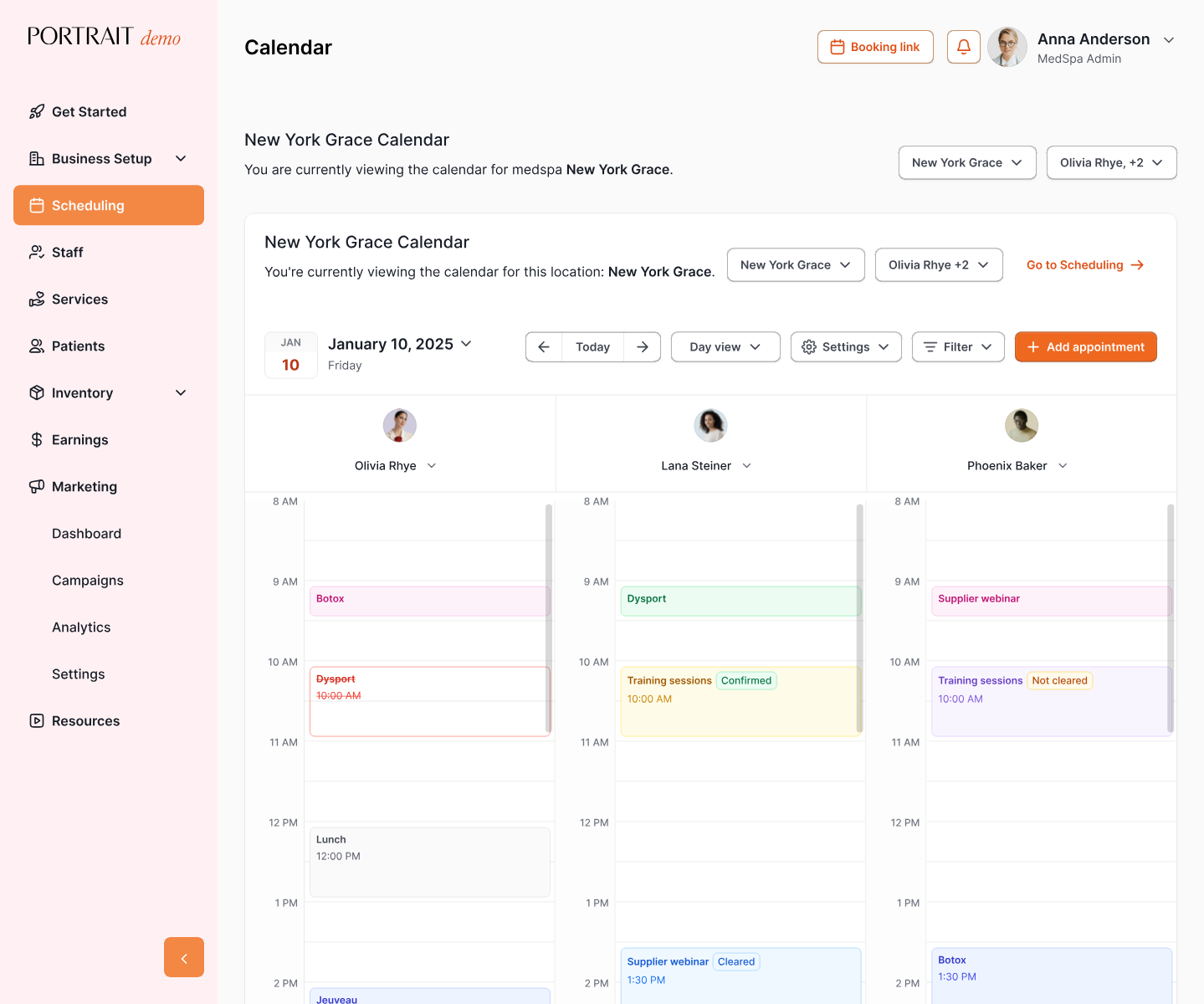


Stay Connected with Portrait Care
Subscribe to our email list and receive the latest insights, updates, and exclusive content delivered straight to your inbox.